
How AI Reduces Claim Denials: A Guide to Autonomous Medical Coding
Every denied claim is delayed cash and wasted staff time. Here is how AI-driven medical coding is cutting denials and getting clinics paid faster.

Insights
AI/ML
Reception is doing three things at once: a patient at the desk, a WhatsApp ping, and a ringing line. The line loses. The person on the other end does not leave a voicemail. They search again and book somewhere that picked up.
That is not a “customer service” story. It is leaked calendar. Evening and Friday overflow are the worst, because the clinic is still open in the patient’s mind. Your hours on Google said you were available. The phone said otherwise.
Most clinic calls are not clinical. They are “are you open,” “do you take this insurer,” “can I move Thursday,” “what should I bring.” A trained voice agent can finish those in Arabic or English and pass anything real to a human. The AI Call Agent is built for that split: routine answers now, genuine cases to your team.
Book a free consultation with our healthcare software team in Manama.
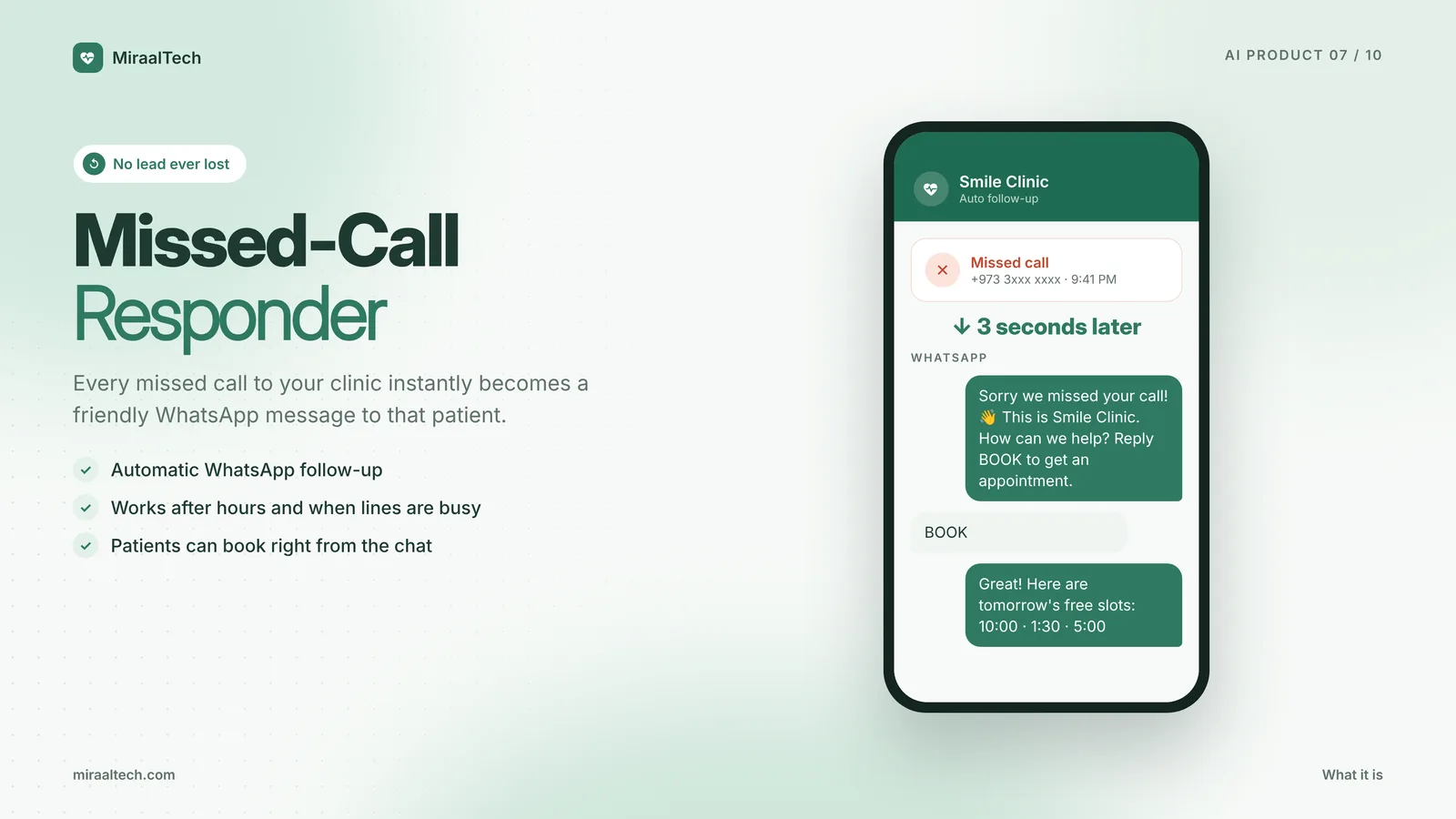
Even a good agent will not catch every simultaneous ring. The recovery is a WhatsApp message that lands in seconds: we saw your call, here is a link to book, or reply here. Missed-Call WhatsApp Responder turns a dead ring into a thread. Patients already live in WhatsApp. Meeting them there is not a gimmick. It is where they would have typed anyway.
Count unanswered calls for a week. Count how many of those numbers appear in your booking system the next day. The gap is the patients you already paid to attract with ads and signage. Fixing the phone is usually cheaper than another campaign.
A clinic does not need a bigger reception roster to stop losing those leads. It needs the line answered at 9 p.m., and a WhatsApp waiting if the line was busy at 9 a.m.
Hifza Israr
Business Analyst

Every denied claim is delayed cash and wasted staff time. Here is how AI-driven medical coding is cutting denials and getting clinics paid faster.

The GCC and Pakistan are on very different paths with healthcare AI. Here is where both are heading.

Patients are already asking AI about their health before they call you. Here is how to use it safely.
We use cookies to improve your experience on our site. By continuing, you agree to our Cookies Policy and Privacy Policy.